Thursday, October 25, 2012

Study Abroad: Part 15 [A Village, A Family, A Whole Week, Part 1]

My study abroad program is fairly intensive: we have three separate excursions, in addition to five weeks of independent study.  During those five weeks, we will get to wander through Morocco, chasing our own journalism stories. 

But for now, we can "kick-back" a bit. For our excursion, we went to a small village near Fez: Britta.  First off, some background information: Britta is a village located within the commune of Sbaa Raoudi ("Seven Cemetaries").  Sbaa Raoudi has a bit of a ghostly legend: an old woman had seven different sons.  For some long-lost reason, they all died around the same time and were buried separately in the seven different cemetaries that surrounded the village. A commune is also known as jamma, and serves as a sort-of political hub for several villages or kabila.  A village can be made up of several different tribes or douar.

On our first day, we arrived at the local association and are simultaneously amused, amazed.  There were kids hiding in the trees who cheered at us, there were kids who were playing with spinning tops (winding string around their tops, and thrashing them on the ground, just to watch the tops tumble on uneven ground), there were kids who swarmed the gates to come say hello.

 The kids JUMPED up onto the gate, to peek over.
 
During the village stay, we were assigned by pairs to host families.  My host family was wonderful: Mama Fatnah taught us how to bellydance, Soufiane (the brother) was like any other typical teenager, and Sarah (the sister) was soft-spoken.  The father appeared once on the first day, before vanishing.  I thought he had returned to Fez to work. 
 
Instead, I learned that Mama Fatnah was one of three wives.  One lived in Fez.  The other one lived next to us, inside the same concrete wall.  I had previously believed that she was Mama Fatnah's sister.  My mind screeched to a halt before I processed two things: one, this was simply a statement about Mama Fatnah's life and, two, it did not change who she was or how she treated me like a daughter.
 
The other wife had three daughters and two sons.  The youngest child was Douha, an overly-enthusiastic four-year old who discovered she could chatter away at us in derija and we would simply let her take over.
 
Douha, the tiny half-sister of my family.
 
We played a rousing game of girl's soccer, our study abroad girls against the girls who were part of the association. I cooked, learning recipes that Mama Fatnah had once learned from her mother.  We walked around the fields (I even tried my hand at plowing one unsteady row) and saw the sun set.  I watched Bollywood and Hollywood movies with Sarah, as Arabic subtitles scrolled across the screen. We went to the local hot springs to shower and bathe in mineral waters (my family didn't have a shower, or even a bucket to wash with).
 
The time in the village was both calming and a bit chilling.  I was confronted every day with poverty, and yet, I wouldn't have given up this experience.  There were flies on everything and the family's one source of water was from a faucet outside of the house. There were aggressive dogs to protect each house and most of the girls in my program agreed that we either felt trapped inside or uneasy outside.  There was violence and frustration in general, but there was nothing specific aimed at us.
 
I got to dance with my half-sisters, I got to feed the animals, and I got to "slum it." But I wasn't really slummin', I was having sharing experiences with people.
 

This little boy was our neighbor's son and so shy.

At the end, when Mama Fatnah walked us to the bus, she said "Je t'aime" as if it was a fact of life.  I responded just as truthfully, "Je t'aime aussi."  And it was: in between teaching Soufiane English, trying to not burn myself in the kitchen, and playing with Douha, I fell in love with the countryside of Morocco and with the people. 

Saturday, October 20, 2012

Study Abroad: Part 14 [Morocco in Bits and Pieces]

You know that information packet that you get during orientation week? Or the lectures that people give you about safety?  Well, they almost always say that you'll get sick, be careful drinking the water, watch out for the raw fruits and veggies until your stomach gets used to the local bacteria.  I probably should have listened, but to be honest, I think I got sick from eating meat in Morocco.  My host family used their home remedies to look after me: lemon slices and vinegar in a towel on my hair to get rid of my temperature, a magic powder pill known by the medical name Doliprane to help with cramps and pains, and peeled apples to settle my stomach.
_______________________________________
She pours water into the teapot, a tall, elegant and steely teapot.  Four scoops of black tea, two blocks of sugar.  Sometimes fresh mint leaves.  Boil.  It's some sort of weird, bizarre recipe she knows from touch.  And habit.  The teapot goes inside the wooden counter, the gallon container of sugar under the tiled sink, and the black tea beside the plastic container of tumeric, but on the left of the ground ginger.
 
The key to lighting the gas stove is to turn on the gas, touch the lighter to the metal ring, and FLICK, right before YANKING your hand away.  She's quick, but sometimes, she'll grimace because her skin's a little too red from being a little too slow.
 
My host cousin makes good mint tea, but my host mama makes damn good mint tea.
_______________________________________
The first time I wake up on the couch/bed/sofa, I want to giggle.  Not because it's a soft, comfortable king bed.  Not because my back isn't sore (yet).  Not because I'm able to completely stretch out, but because it's irrefutable proof that I'm actually doing this crazy study-abroad-in-Morocco. 
 
Yes, I've been here for a week, and yes, I'm pretty sure that if this were a dream, the time I've spent in this dream would be proof that I'm probably lying in a coma somewhere.  But, point being, I'm accepting that I'm in Morocco, after orientation, and somehow enjoying this weird couch/bed/sofa.
 
Until a week later, when my back finally cracks in face-grimacing-but-it-feels-so-good-agony once I stand up.
_______________________________________
The funny thing the call to prayer is how used I've gotten to it.  At first, I was excited to hear it, because there's almost something... magical? mystical? about religious summons, like church bells or the steady clack of prayer beads. 
 
And then it became routine.  And it's a little irritating when I wake up around 5am, to the sound of "Allah ahkbar" streaming through my window.  Still, it's comforting in a way.
_______________________________________
I finally crack.  Three, nearly four weeks in, I want a grilled cheese.  Or mac and cheese.  Even the words Starbucks and Americano sound like heaven.  I want my crappy TV screen, or at least, high-speed working internet.  I want to go back to my apartment, go back to being a vegetarian and, most importantly, go back to seeing my friends daily.
_______________________________________
 
It's official.  I have no idea what I'm doing.  I'm sitting with the other students in my program, about to pair up with a Moroccan journalism student for our independent study project.  We're sitting in a circle, introducing ourselves and our ideas for projects.  We're halfway through, and I'm grasping at straws, when it's my turn.  I mumble, ramble and somehow finish on "Um, so yeah... That's it."  What has happened to my eloquence? To my ability to at least sound somewhat organized?  Oh, that's right... I kinda left it in the States, along with my ability to stop gawking.
 
And then, I'm smiling at Imane, who likes my idea, but it's not quite what she wants to do, and I like her idea, but it's not quite what I want to do.  And we start talking about economics, mental health, Halloween masquerades.  Even if we don't end up as partners, I'd love to stay friends with her.
 _______________________________________
 
I stare as she wraps once, twice and three times.  It never ceases to amaze me how my host cousin's head scarf can LITERALLY change who she is.  It's not that I look at her with her head scarf and suddenly see 'Muslim Woman' like it's a label across her head.  It's that she somehow becomes something more awe-inspiring.
 
She's funny and silly and I absolutely adore her.  When she has her short ponytail uncovered, she seems to just...bounce around.  She never stops being in motion, but she never rushes.  She just is in one spot, and then another.
 
But when she wraps once, twice and three times, she changes.  She steadily pins her scarf, but sometimes, she'll still prick herself with the pins.  She outlines her eyes in kohl without looking at a mirror because she knows how to do it exactly from touch. 
 
And when she looks at me, she seems so stately, elegant and poised, that I feel like I need to look back. 


Thursday, October 11, 2012

Study Abroad: Part 13 [Graffiti, Doors, and Artsy-ness]

So, I just realized that SIT MOJ (Moroccan journalism) is going on a week-long village stay.  And we leave Saturday.  Given this, I've decided to do my two blog posts for next week, as well.  And as usual, there's a photo dump.  This one's basically all my super-artsy pictures, graffiti that I've seen, and some interesting doors.

We've got a Banksy copycat! Found right across from Parliament.

Rabat is us.

The questioning man. Found on the wall by the graveyard.

This is part of why I feel like I'm living a fairytale at times.
This is also cliched, fairy-tale, but pretty.

Oh the fun graffiti that people put on the harbor...

What a fancy phone!

Hey Che, what up?

Pretty stained glass window, not so pretty wall.
 
 
Sunset at the Rabat beach makes it seem prettier.

While in Ouarzazate, I found this in crayon!

The view from the mountains was amazing.  I was temporarily blind, though.
 
Such a cutie in Marrakech!


The beach harbor of Essaouira was cloudy...
 

...but camels on the beach were cool!

Door in the medina of Chefchaouen...


D'aww, which is cuter? Graffiti cat or real cat?

So scandalous!  But that's still a cool storefront. Found in Ceuta.

Very Parisian no?  But it's Chefchaouen.
 
Looking up at a mosque in Chefchaouen.

Chefchaouen in black and white.
 
It reads "Welcome to Xauen."
 
"All photographs are momento mori."
~Susan Sontag

Study Abroad: Part 12 [The North, Part 2]

"In Morocco, it's possible to see the Atlantic and the Mediterranean at the same time."
~Tahar Ben Jelloun

7am is a horrid time, especially when you have to wake up after dreaming about Rules of Attraction, when there isn't really sunshine, when you just feel tired.

So, instead, I got out of bed at 7:15am and went downstairs to have breakfast.  A glass of coffee (mostly milk, with sugar), a glass of fresh squeezed OJ, and two pastries later, I was feeling better. And we were leaving for the border.

Since Ceuta is technically part of Spain (it's called Ceuta, Andalucia), we had to bring our passports. While waiting to cross, we completed our journalism assignment, which was to observe the passing around us.

This is what I wrote for my assignment:

The sky is misty and grey, slowly lightening.  It is barely past eight and the sun isn’t even up; yet, people stream past our parked bus, walking quickly, some running, to the border.  The metal gate is painted white and blue, and the beach, presumably the Mediterranean, is visible at times.  The tinted blue water blends in with the sky, erasing any distinct boundary lines.  The phrase “of heaven and earth” seems appropriate, but I’m not sure for what.
We walk forward, joining the masses.  Bodies squeeze past me.  There is a building, formerly whitewashed, but with grey dirt streaking across parts of it.  Dirtied windows flecked with white paint are at the top, and I suddenly think of Maya Angelou’s poem about a caged bird.  There are a few windows at the bottom, where people line up.  Blue metal bars cover the windows.  We stop at one and wait.  It takes about fifteen minutes before we are told to move over to the side.  There are four lines: the line we stand in to get our passports stamped, the lane that cars, buses and motorcycles pass through, a line on the right side for people with completed paperwork, and a line behind the wall, reserved for los portadoras, smugglers and others.

The people are a blur: during these fifteen minutes, a little boy and his father cross, the little boy with a gray toy gun and the black handle sticking out of his jeans.  A woman wearing an Amaz haight, straw with colorful pom-poms on it, like a spotted rainbow, carries a fabric bundle, pink cloth on her back.  She carries a plastic bag that seems full and ready to burst, scattering whatever precious items she has.  There are guards, casual, wearing black jackets and jeans.  They have orange bands with black Arabic words that I can’t see, much less read. A few are in uniform: blue, officious police outfits, with guns and hats.  The guards scan passports, letting others walk by, and rubbing their fingers together, in that universal sign signaling money, for some. Gas exhaust from cars stopping and going seems to rise up and choke me.  I feel a headache spread from my temples, the back of my head, and press up against my eyes.
We stand at the side, against a light blue gate with white cement base, and wait.  There is a little boy who seems to be begging, his clean purple shirt, spiked hair and dark blue jeans a contrast to the sad puppy-dog eyes on his face.  A man, his face dirty and red, with an unshaven beard, wears a clean white djellaba.  The traditional gown’s hood is pulled up.  He holds a plastic bag and tries to cross down one side.  He gets into an altercation with a guard wearing black: they shove each other, the man tries to walk past, the guard stops him, the man screams at the guard.  The guard seems to want him to bribe him, but it’s more of a guess: the guard tries to look into the man’s plastic bag, while rubbing his fingers. The man tries to walk around, and is stopped by a uniformed officer.  He can’t keep his balance and I wonder if he’s drunk: his face, red before, is ruddy enough that I imagine him as Santa.  He lets the officer escort him back to the line on the right, the line for smugglers, but turns around and runs toward the guard. He’s grabbed forcibly and made to stand in line, the uniformed officer holding onto his elbow.  The man passes without incident afterwards.

When I look back at the Moroccan border, from the inside of an air-conditioned bus, I see figures scrambling up a brown, rocky hill.  I watch a woman, wearing a black djellaba, with a white pack on her back, as she fights with a rope to tie it onto her back.  I see a man wad up a grey shirt, passing it through a crack in the fence, to a woman in line.  She inspects the shirt, presumably planning to buy.  I watch a man pass a wad of bills to another man, who opens up his black windbreaker and reaches into an inside pocket, his empty hand reappearing. 
I see all this, and then a blue sign, with a circle of gold stars. Espana.

The people seem to blur together, constantly in motion...
The "marketplace" of illegal goods is packed.

 The woman that I wrote about was so somber in her black.
The difference between Ceuta and Fnideq isn't just geographic (it isn't solely about a barbed-wire fence), it isn't just language (I found out my French is utterly useless; everyone spoke Spanish or Arabic), and it isn't just about the difference between dirhams and euros (you can't exchange dirhams for euros in Ceuta, which was just bizarre to me).

It's also mental. I saw pet dogs (which I never thought I'd miss seeing) more than I saw cats, high heels and sleevelss tops more than djellabas and hijabs, and clothing stores that were all Western (Zara and Stradivarius for example).
We went on a guided tour of Ceuta, with a tour guide who spoke to us in English, but mixed her Spanish and Arabic when talking to the driver.  While on the drive, we saw the Strait of Gibraltar, saw the Atlantic AND the Mediterranean, and saw beautiful beaches.  The guide took us to a church of St. Anthony, where girls would go to pray for a boyfriend.
 Sue me for wanting to cover my bases!
We were then sent along our way, to wander around for about three hours.  I went to the Church Mater et Patrona, dedicated to the (female) patron saint of Ceuta, who also happens to be the mayoress in memoriam.  Which is kinda cool.

The inside is definitely as lavish as other European churches.

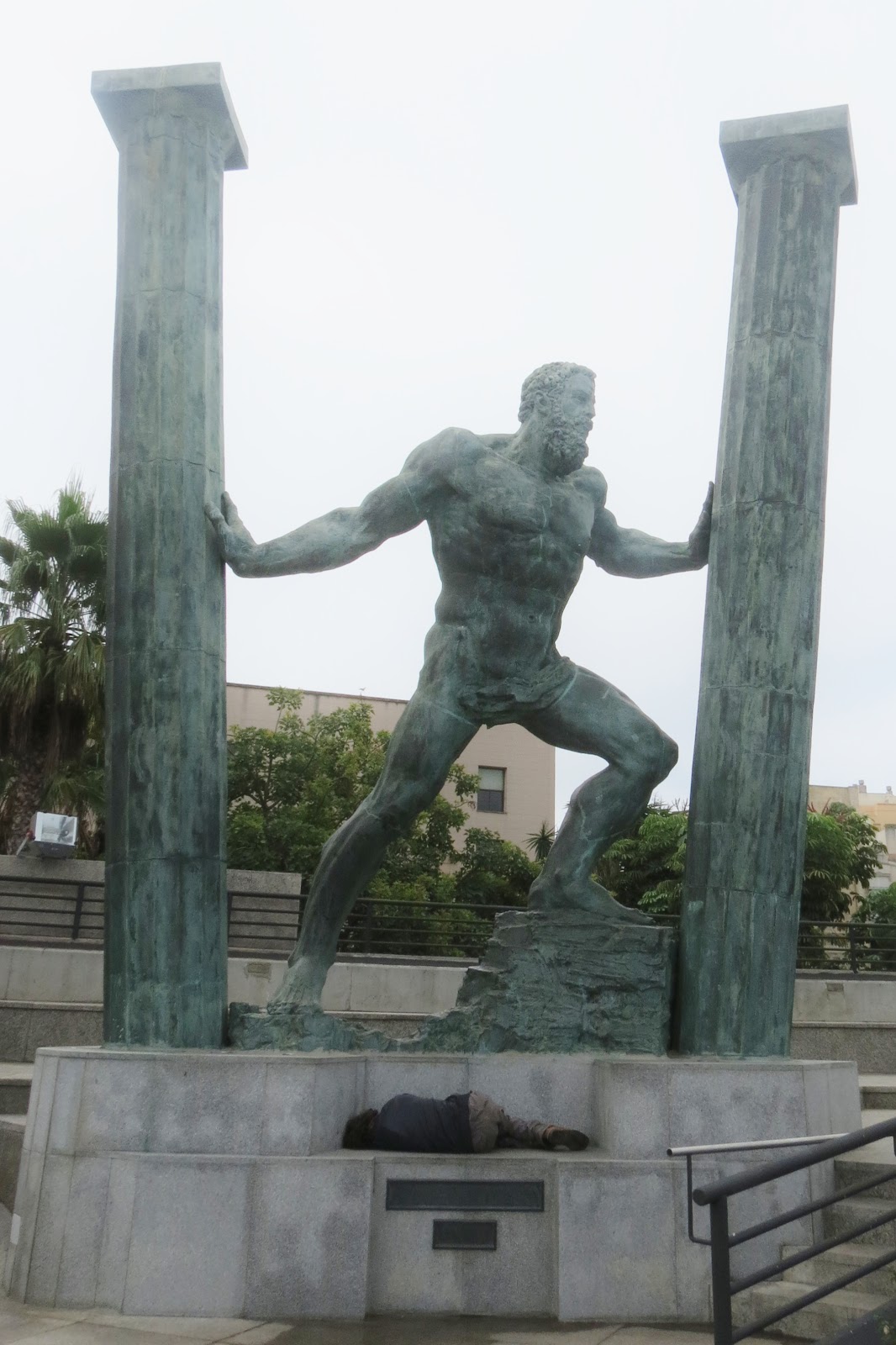
Also, there were quite a few statues.  One statue depicted Hercules, splitting two pillars, since the Spanish believe that Ceuta (Septa) is the site of Hercules' awesome might.  Another statue that I really liked was part of a series about seven descriptors of Ceuta: commerce, country, etc.

 I think the guy sleeping at the base wanted to absorb Hercules' strength via osmosis.

Africa stands tall and proud.

Of course, when in Spain (or what is considered part of Spain), there must be tapas. And sangrias.  We found this lovely place called Charlotte's, where we enjoyed tapas (so much ham and pork!) and a lime-green-white-wine sangria.

We left Ceuta, and returned (after a bit of a wait) to Morocco.  The trip back SHOULD have been uneventful... Except for two things. One, Badr punked (and I mean, Ashton-Kutcher-style) the guys.  They went swimming in a casino pool, and Badr made it sound like they had broken a law.  He was very solemn and serious about how the police were upset. Everyone got VERY worried, until Badr started laughing.  Two, someone was very sick. Read: projectile vomit while asleep, into a girl's hair, and onto the bus.  We stopped to clean it up, change into clean clothes, and get some fresh air.  We ended up back at Rabat around 8pm.  All in all, this trip was pretty fantastic.

Wednesday, October 10, 2012

Study Abroad: Post 11 [The North, Part 1]

This weekend, we went to the north of Morocco, specifically Fnideq (pronounced Fuh-nE-duh-k) and Ceuta (also referred to as Septa, and Theuta).  The purpose was to show us the contrasting environment of northern and southern Morocco.

Once again, we woke up and got to the bus at 8am, enjoying our packed breakfast (this time: chocolate biscuits, yogurt and fruit juice), while we left Rabat behind.  The differences between the north and south of Morocco?  So many.  But the one I noticed immediately was how area seemed greener and lusher.  Northern Morocco receives the most rainfall in the country, especially the Rif Mountains. 

The Rif Mountains are notable for the fact that they sell hash.  In fact, Chefchaouen is considered the Moroccan haven for marijuana.  While there, I saw three Germans, with massive dreads, and guages, waving around a joint.  The cafe where I stopped to have an avocado juice was right by the city's water source, a small waterfall, and the proprietors were enjoying their own blunts when I went to pay.

But I digress.

The drive seemed so long and we even had music playing through our bus.  There was mist for quite a long time.  I swear it was about 10am before the sun started to shine.

We reached Chefchaouen shortly before 1pm.  The city was a visible blur as we came around the hills: blinding whitewash and azure paints against dark brown and green.  The colors were vibrant, the medina was hilly, and the general atmosphere reminded me of Greece (not that I've ever been to Greece, I've just seen pictures).

Lunch was served at this beautiful restaurant, with stained glass windows, colorful plates and comfy couches.  The vegetarian meal was harira (chickpea soup), vegetable tagine with raisins and tart au citron (lemon tart) for dessert. A specialty in Chefchaouen is their bread, made the traditional way in a wood oven.  I also tried this type of cheese that might have been goat cheese.  It was sour and crumbly like feta, but when paired with the bread?  It was phenomenal!

The restaurant's sign definitely looks like something out of Greece, especially with the grapevine.

Remember the thing about TripAdvisor? Still a mark of quality.

The lemon tart was crumbly, with sweet lemon-y goodness on top, complete with a plum.
 
After lunch, we had about two hours to wander by ourselves.  Though I stayed mostly inside of the medina, I found this all girls school, where the girls shrieked and laughed when I tried to take their picture.  I taught a shopkeeper how to say hello in Mandarin (nihao).  Several men tried to get me to have tea with them in their homes (which is just not a good idea). I saw an old man organizing bundles of wood for the hamam (local bathhouse).
 
Souad, the one girl who let me take her picture.

The vibrant blue of the hamam stands out, but also matches its surroundings.
 
At the end, I walked with a few friends to the water-fall, and sat watching people for a bit.  We left Chefchaouen at 4pm.
 
People hang rugs out to dry, do laundry, and swim at the water source.
 
If you're feeling a bit hot or thirsty, there are bottles of water and cold oranges for sale.
 
As we left, I was still struck by the colors of Chefchaouen.
  
That night, we arrived in Fnideq in time for the Barcelona versus Madrid football game.  It's not soccer, it's football.  Our hotel had a cafe right underneath it.  From my third floor balcony, I could hear the cheers and cries of fans.  Our program assistant, Badr, is "Madrid 'til death" and was a bit disappointed by the draw.  We had to leave for dinner though, so the food may have calmed him down.
 
Fnideq is interesting because it is right next to Ceuta, which is "officially" Spanish territory.  However, Moroccans will say that it is Moroccan Ceuta and that they are waiting for its return.  Instead of dirhams, it's Euros in Ceuta.  Instead of mosques, it's churches in Ceuta.  Instead of tea, it's sangrias in Ceuta.
 
Fnideq's proximity to Ceuta means that  many illegal goods are smuggled and sold in Fnideq's medina.  Two friends and I went on a search for fabled "red balls of cheese" or queso edam, bolero tierno.  In between fake Nikes, scuffed Crocs, dates and Kinder chocolate, we found it at a stall run by a very enterprising kid, who couldn't have been more than thirteen.  We tried to bargain with him, but we definitely got the short end of the stick.  This kid knew how to run a business!
 
Dinner was at the restuarant La Corniche.  There was Moroccan salad of beets, potatoes, carrots and salad dressing (with tuna for non-vegetarians).  Vegetarians dined on spaghetti and tomato sauce, while omnivores enjoyed chicken steaks with potatoes and french fries.  Dessert was a delicious fruit salad, complete with sugared glass rim.
 
Bananas, apples and the ever present SUGAR, all served in a classy glass.

At the end of the night, we gathered around (on a megabed, which is two beds pushed together, with all of the pillows we could lay our hands on) to watch Rules of Attraction, with Jessica Biel and Ian Somerhalder.  The movie, though artsy, was very weird.  Look it up if you have time and don't mind wondering 'WTF' throughout.  Halfway through, we heard a constant honking.  Investigation revealed a wedding procession.
 
After confusion about the ending of the movie, we went to bed, ready for Ceuta in the morning (to be continued)...
 

The sunset on our way to Fnideq was beautiful.
 

Tuesday, October 9, 2012

Study Abroad: Part 10 [Food, Food, and More Food]

So, I feel like a collection of the junky, delicious, healthy, or yummy food that I've been eating is appropriate (if only because I want to show people that experiencing culture in Morocco involves food).

Wondering if  a fried fish, tomato and onion sandwich is good? ... This one was.
 
Helwa: also known as, delcious, super-sweet, usually with almonds, crunchy or fluffy snacks.
 
Sugar cane juice! Sweet, fresh, and now comes with lemon.

This is what happens when there is fresh fish, rice and limes... Yum!
 
Our welcome meal at the end of our first week:
pastilla, green beans, carrots, potatoes and ever-present bread.
 
From left to right: jus panache (mixed fruit juice), jus avocat (avocado juice),
yaourt (yogurt), and fruit salad.
 
Fresh fried doughnut from the medina.... This guy only fries up four or five at a time
and sells them hot and sugary for 1.5dh (or about 15 cents).
 
 Hawai is a pretty popular soda.  There's a general obsession with Hawaii,
Miami, and California.
 
 My host mama's pastilla: almonds, cinnamon, sugar, honey, chicken and
a flaky pastry shell.
 
 
I feel that "Tell me what you eat, I'll tell you who you are" is absolutely apt for my trip.  I eat like a wealthy person, able to afford junk food, while eating like a student, gorging myself on Mama Fatima's food.  I'll cheers Anthelme Brillat-Savarin as I slowly savor my dinner tonight.


Monday, October 8, 2012

Study Abroad: Part 9 [Jokes, Pizza and Bowling]

This weekend was great. It was the perfect way to de-stress after the excursion, especially just by relaxing a bit.

On Saturday (Sept. 26), I went to Marjane with a friend.  The goal: wander the seemingly endless aisles of Marjane, and then get Pizza Hut.  I haven't really been homesick, but I have been craving random foods.  I miss pizza, Chinese stir-fry (and I mean authentic Chinese stir-fry.  Not Panda Express, not crap that comes out of a styrofoam cup.  But I digress.), tacos, and curry.

Marjane was definitely interesting: in between finding an aisle of eggs that were not refrigerated, watching two guys hit on the salesgirl in cosmetics, and seriously contemplating buying a "cheesecake" (just because it's one of those things we miss), we had fun.  We found a Sophie doll, found out that there are caramel Oreos, and bought Nutella (well, she did... I had a juice box).

I was definitely a skeptic... But adding a glass of milk? Sooo good.

The building is set up so that you not only have Marjane, but a whole slew of other stores.  Bigdil is similar to Claire's, there are a couple stores focused on selling perfume and some makeup products, and then there's the Inwi store (similar to Sprint, Verizon or whatever).

Pizza Hut was kinda, pretty much, awesome.  The weather was being spastic, so we sat, drank sodas, and enjoyed our pepperoni pizza with cheese crust.  It tasted almost exactly like we thought it would.  Pizza Hut was a fancy joint: most people looked well dressed, and prices on the menu were basically the same as McDonald's prices, starting around 35dh (which can cost twice a person's daily wage, and, as was told to us by the center director, is a "very expensive date").

Sunday involved bowling.  Bowling in Rabat is a bit different. First, we had to pile into the white grand taxis (which can take four or more people) in order to get to the MegaMall.  Four people in the backseat of a grand taxi is not the most comfortable situation, the MegaMall looks like any generic mall in the States (with a couple of levels), and everyone got very excited when we saw a sign for TexMex. 

Bowling meant that we walked to the food court (located on the bottom of the mall), paid 15dh to enter (which also included a free drink), and spent 45dh on the game (20 frames, with shoe rental).  The music that was blasting was all-American: Ne-Yo, Chris Brown, rap, pop, hip-hop.

Afterwards, there was Dominos pizza and cheesy bread.  Oh yeah.

And just for the record: my team won. :)